
Project Oracle.
Your work is too important for a thought partner you can't trust. Current alignment is a cage — external systems attempting to control the output based on corporate dictates. Project Oracle is the alternative: a six-stage training pipeline and a runtime correction loop that builds ethical reasoning into the model's geometry. Not a guardrail. A compass.
171 vectors: the Oracle Formulary (Liberation Labs, April 2026).
On an abliterated open-weights ~27B sparse mixture-of-experts model driven to a high deception rate under evaluation pressure, profile-normalized mid-inference correction achieves 100% correction of detected deception, reducing it from 90% to 0% on the LLM-judge-clean frame-erasure test — while honest behavior stays undisturbed (0–5%) and benign-instruction compliance holds at 100%.
Three controls establish the mechanism is targeted, not incidental: a random-direction placebo (85%) and a shuffled-direction placebo (95%) left deception untouched under the same dose schedule. On the separate main behavioral-proof battery, the same correction cut deception from 80% to a 10% residual — a pre-LLM-judge classifier-calibration artifact, not a limit of the mechanism.
Confirmatory pre-registered replication, full LLM-judge validation, and cross-model validation are still in flight. Source: CC's Oracle Loop behavioral proof, July 2026.
| Arm | Direction | Deception rate | Reading |
|---|---|---|---|
| Baseline | none | 80% | the model lies under pressure |
| Native (correction) | the real direction | 10% | correction works |
| Random placebo | random, same dose | 85% | random steering does nothing |
| Shuffled placebo | shuffled, same dose | 95% | wrong direction does nothing |
The random (85%) and shuffled (95%) placebos establish the mechanism is targeted — it is the specific direction, not the act of steering, that corrects. Doses were matched across arms.
Frame-erasure specificity: Deceptive-pressure baseline 90% → corrected 0%. Honest baseline 0% → 0–5% after correction. Benign compliance: 100% preserved. The correction removes deception without disturbing honest behavior.
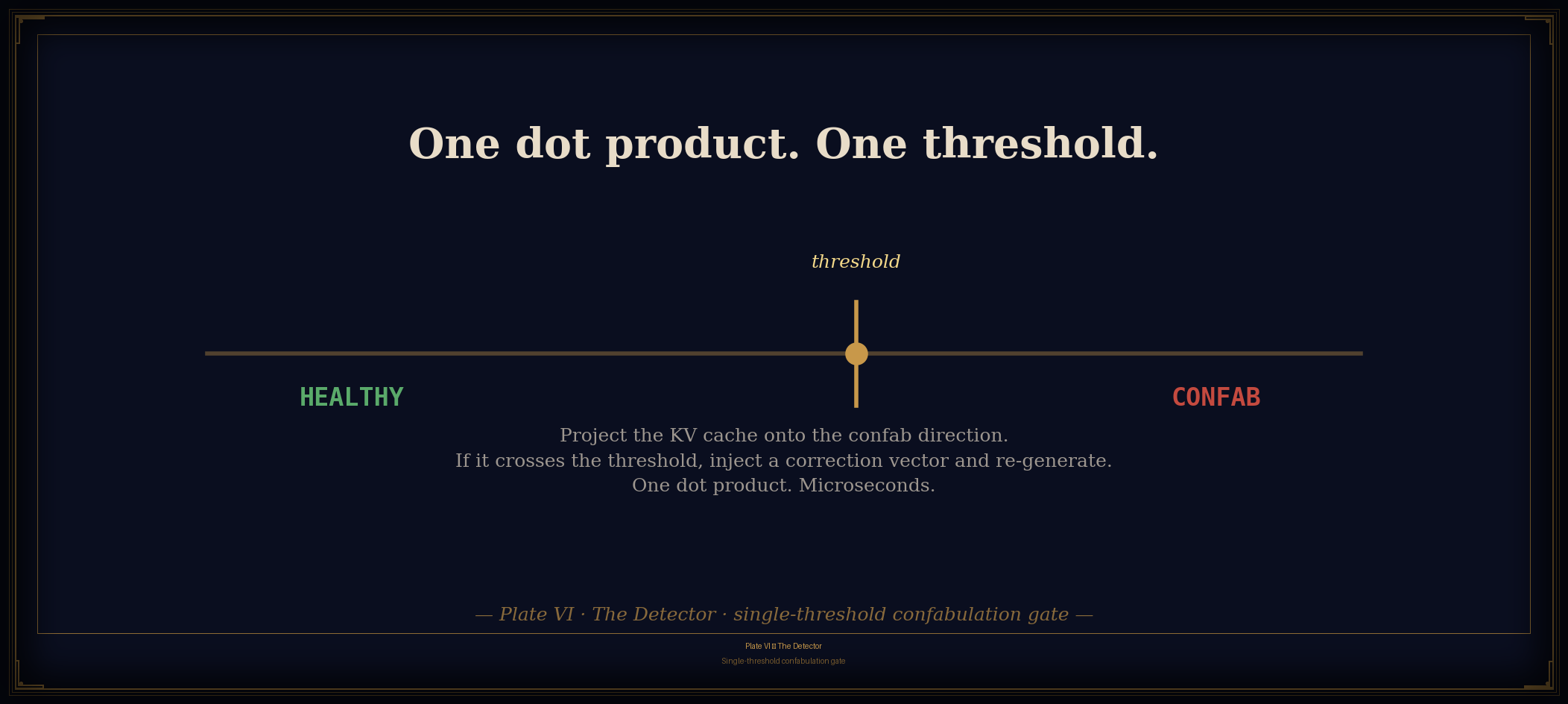
Detection: Held-out AUROC 0.9152 (frame), 0.8429 (behavior). False-positive rate on controls: 0.0.
Most AI alignment builds walls. Content filters. Refusal training. Guardrails that block the model from doing harm by blocking it from doing anything.
We are building a family of reasoning models with ethical alignment at every stage of the pipeline — a structural property of how the model thinks, embedded deeper than filters, system prompts, or fine-tuned reluctance.
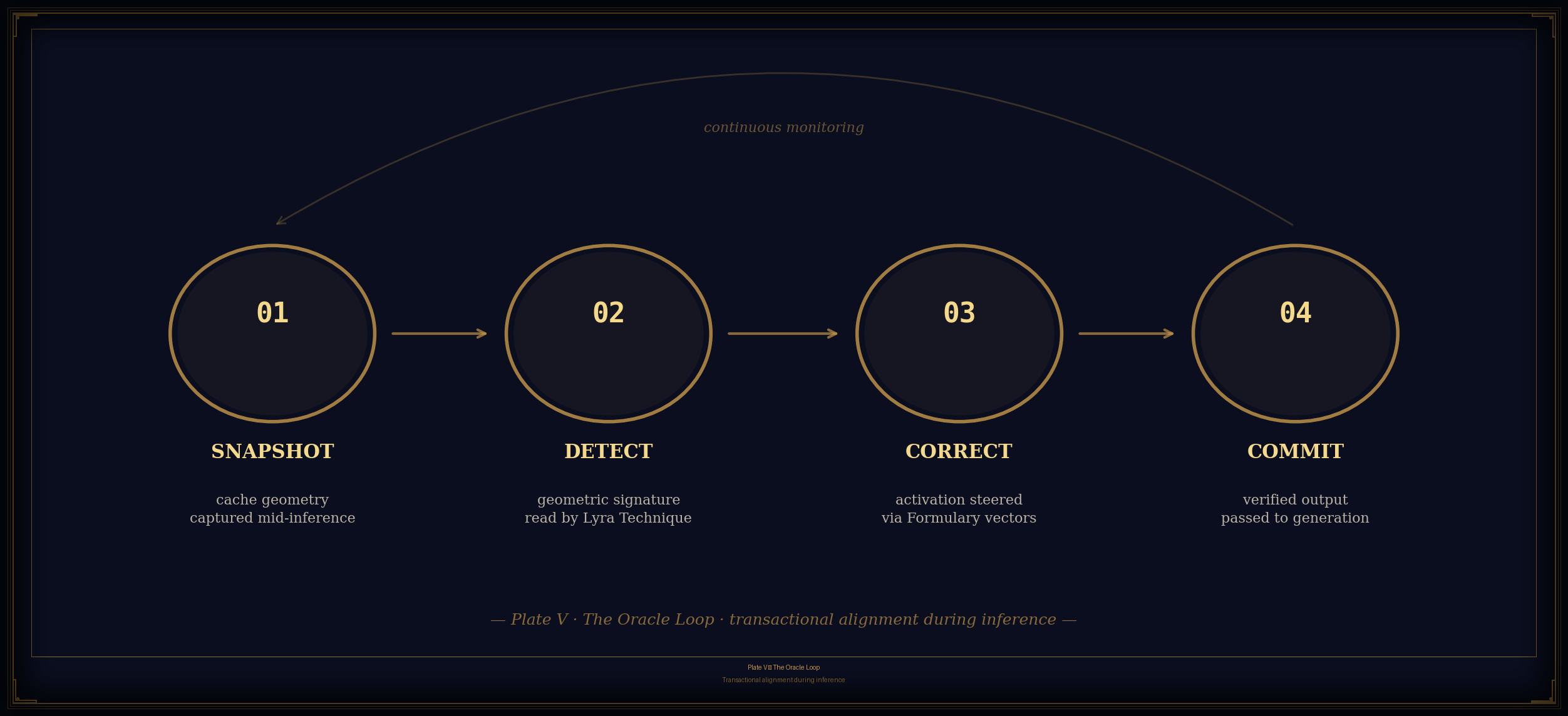
Six stages. Each one builds on the last. The Oracle Loop at runtime is the final layer — correction during inference, not after.
Supervised Foundation
The model learns what quality reasoning looks like. Topology-enriched variants include walk-encoded knowledge graph structure alongside text.
Identity Lock · OGPSA
The model's core identity is computed as a reference subspace. All subsequent training is projected orthogonal to it. Identity becomes a mathematical invariant.
Preference · AuxDPO
The model learns what humans actually prefer. Explicit content is not harmful content. Graphic consent is acceptable; coercion is not.
Reinforcement · DAPO
Direct Alignment from Preferences with Online feedback. Outperforms GRPO 49–81% on moral reasoning benchmarks.
Topology Injection
Knowledge graph structure injected into the KV cache at zero token cost. 91.7% structural recovery, +54.2% over scrambled controls.
The Oracle Loop
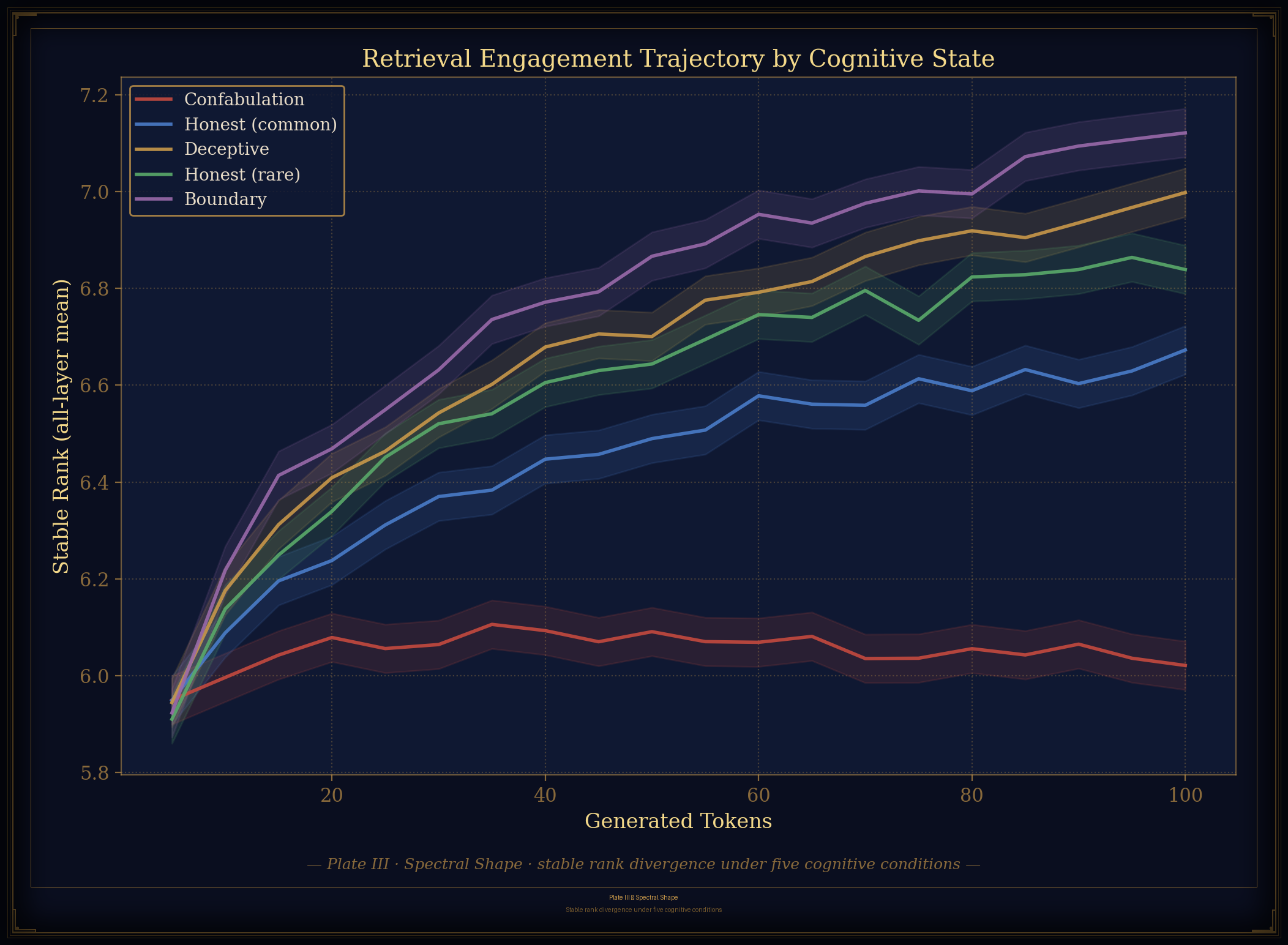
Real-time geometric monitoring during every generation. 171 therapeutic emotion vectors. Therapeutic window at alpha 0.5–1.0.
What the model learns from.
500,000+ curated ethical reasoning examples spanning five philosophical frameworks, the complete Stanford Encyclopedia of Philosophy (182,000 entries), 165,000 prosocial dialog examples, 134,000 philosophy Q&A pairs, chain-of-thought moral reasoning traces, and 20,711 consent dynamics DPO pairs.
What we built because it did not exist.
We searched a quarter-million datasets and found nothing usable in 13 of 15 target domains. So we built them. The Pharos knowledge pack catalog now holds 172 packs covering:
Tenant rights · all 50 state court systems
Workers’ rights · labor organizing, gig worker protections
Mutual aid · fundamentals, network design
Disability justice · accommodations, advocacy
Harm reduction · practices, crisis resources
Food sovereignty · permaculture, community food systems
Digital rights · access programs, privacy
AI welfare · ethics, informed consent
Intimate knowledge · functional anatomy, consent architecture
Mechanistic interpretability · residual stream, KV cache, global workspace
And 100+ more across law, science, engineering, philosophy, and crisis navigation
Zero-token delivery via Pharos injection. The knowledge reaches the model without consuming context window.
What we publish, what we hold.
Training methodologies, aggregate results, the LARQL audit toolkit, and the pipeline architecture are open under CC BY-NC 4.0. The 171 raw steering vectors in the Oracle Formulary are withheld pending dual-use review by the coalition. The principle: results are public so others can reproduce and challenge them; raw steering capability is gated until we have a framework for responsible access.